Why Should I Have a Loyalty Program?
Why Should I Have a Loyalty Program?
The plain answer is simple:
To increase profits.
Not revenue. Profits.
That distinction matters, because many business activities can increase revenue while reducing profit. Discounts can do that. Promotions can do that. Advertising can do that. Even a busy day can do that if the margin is too thin.
A good loyalty program should do something more specific: it should increase the share of a customer's spending that goes to your business, and it should do that at a cost lower than the extra profit it creates.
That is the real test.
Not "do customers like the reward?" Not "does the program look nice?" Not even "does revenue go up?"
The right question is:
Does the loyalty program make customers choose you more often, profitably?
Your real competitor is not always next door
Many local businesses think about competition too narrowly.
A café looks at the café across the street. A barber looks at the other barbershop nearby. A salon looks at the salon down the road. A corner shop looks at the supermarket.
Those competitors matter, of course. But they are not the whole picture.
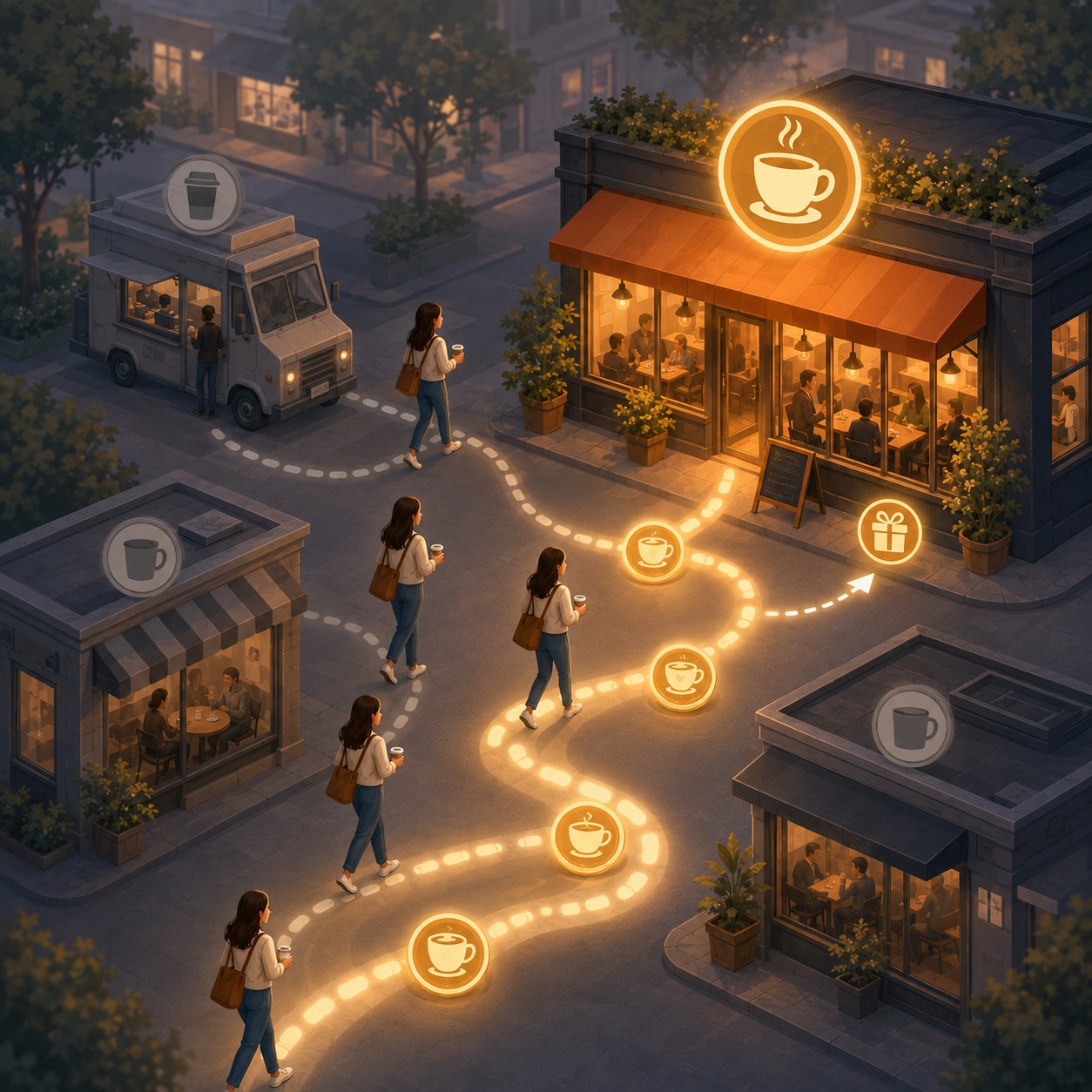
A local café may not have another café directly next to it, but it still competes with the coffee near the customer's office, the coffee from the bakery on the way to work, the vending machine, the corner shop, the petrol station, or the coffee the customer makes at home.
The same logic applies to almost every repeat-purchase business.
- A barber competes with the barber near the customer's office.
- A beauty salon competes with the salon near the customer's home, workplace, or gym.
- A lunch place competes with every other convenient lunch option in the customer's weekly routine.
- A corner shop competes with supermarkets, delivery apps, petrol stations, and other quick stops.
In other words, the question is not only:
"Will the customer buy this product or service?"
The better question is:
"How much of this customer's total spending in this category can we win?"
That is share of wallet.
And for most retail and local service businesses, there is room to win more.
Loyalty is about increasing wallet share
Very few businesses command 100% of a customer's spending in their category.
Most do not even command 50%.
A customer may like your café and still buy coffee elsewhere three times a week. A customer may like your salon and still use another one when it is more convenient. A customer may like your shop and still buy most things somewhere else.
That does not mean the customer is disloyal. It means the customer's life is fragmented.
People buy based on convenience, habit, timing, location, price, mood, and memory. They do not sit down and rationally choose the "best" business every time.
A loyalty program gives your business a small advantage in those repeated decisions.
If a customer is choosing between two acceptable options, and one of them gives visible progress toward a reward, that option has a reason to win more often.
The goal is not to own every purchase.
The goal is to win one more visit, then another, then another.
If the customer usually buys from you twice a month and a loyalty program helps move that to three times a month, that can be meaningful. If the extra visit is profitable after the reward cost, the program is working.
The economics are simple
A loyalty program makes sense when:
The extra gross profit from increased repeat visits is greater than the cost of running the program and giving the rewards.
That is the whole model.
The business does not need to become obsessed with complicated calculations. But the logic must be clear.
- If a reward costs too much, the program can become expensive.
- If the reward is too weak, customers may not care.
- If the program is hard to use, customers may not participate.
- If staff do not mention it, customers may never join.
- If the program is easy, visible, and well-structured, it can increase profitable repeat behaviour.
That is why loyalty is not just a marketing idea. It is an operating model.
The program has costs. Those costs need to be understood.
Cost 1: setup
The first cost is setup.
Someone has to create the program, define the reward, decide how customers will earn progress, and put the system in place.
With traditional approaches, this can involve design, printing, staff instructions, manual tracking, spreadsheets, or software configuration.
With Fix'd, the setup is intentionally fast. A business can create a simple points-based loyalty program without building an app, buying hardware, or designing a complicated system.
That matters because the harder a program is to set up, the less likely it is to launch.
And a loyalty program that never launches has exactly zero return.
Cost 2: ongoing operation
The second cost is the cost of running the program day to day.
This is where many loyalty ideas quietly fail.
If staff have to remember too much, stamp too many cards, explain too many rules, check too many balances, or handle too many exceptions, the program becomes friction. And when a program creates friction, staff stop promoting it and customers stop using it.
A good loyalty program should be operationally light.
This is one of the advantages of a digital QR-based approach. Once the program is set up, customers can scan to earn progress, and the system handles the tracking. There are no paper cards to print again and again, no lost cards to replace, and no manual counting of stamps.
Even compared with traditional stamp cards, the ongoing operational burden can be lower.
That matters because time is also a cost.
If the program saves margin but eats staff attention, it may still be expensive. If it works quietly in the background, it has a much better chance of surviving real daily operations.
Cost 3: customer education
The third cost is customer education.
This is often the hardest part.
Customers need to know the program exists. They need to understand what to do. They need to believe it is simple enough to bother with.
The good news is that customer education does not need to be complicated.
For a simple QR-based loyalty program, the basic instruction can be as short as:
"Scan the QR code to earn points." "Collect points and get a reward."
That is it.
The important thing is not to over-explain. The customer does not need a lecture on loyalty mechanics at checkout. They need a clear prompt at the right moment.
A small sign near the counter, a sentence from the staff member, or a short line on the table can be enough:
"Scan to collect points." "Your next visits count toward a reward."
The business does not need to educate the whole market. It only needs to educate the customers who are already there.
That is a much better starting point than paying to attract strangers with discounts.
Cost 4: the reward
The fourth cost is the reward itself.
This is the obvious cost, but it is not always the biggest one. In many cases, the larger risk is not the reward. The larger risk is a program that is too complicated, too invisible, or too hard for staff to operate.
Still, the reward has to be structured carefully.
The reward should feel meaningful to the customer, but it should not destroy the economics of the visit. Ideally, it should support another transaction rather than completely replace one.
There is no universal perfect reward. A café, salon, barber, restaurant, shop, and service business may all need different structures.
The important principle is this:
The loyalty program should increase wallet share more than the reward costs.
If it does that, the reward is not a giveaway. It is an investment in profitable repeat behaviour.
The real question
So, why should you have a loyalty program?
Not because everyone else has one. Not because customers like free things. Not because it sounds modern. Not because it looks good on a website.
You should have a loyalty program if it helps customers choose you more often, and if the extra profit from those additional visits is greater than the cost of the rewards and the system.
That is the practical reason.
A good loyalty program does not need to be complicated. It does not need to be expensive. It does not need to become a burden for staff.
It needs to do one job well:
Make your business the easier, more rewarding, more natural repeat choice.
If it does that profitably, it is not a marketing expense.
It is a profit tool.