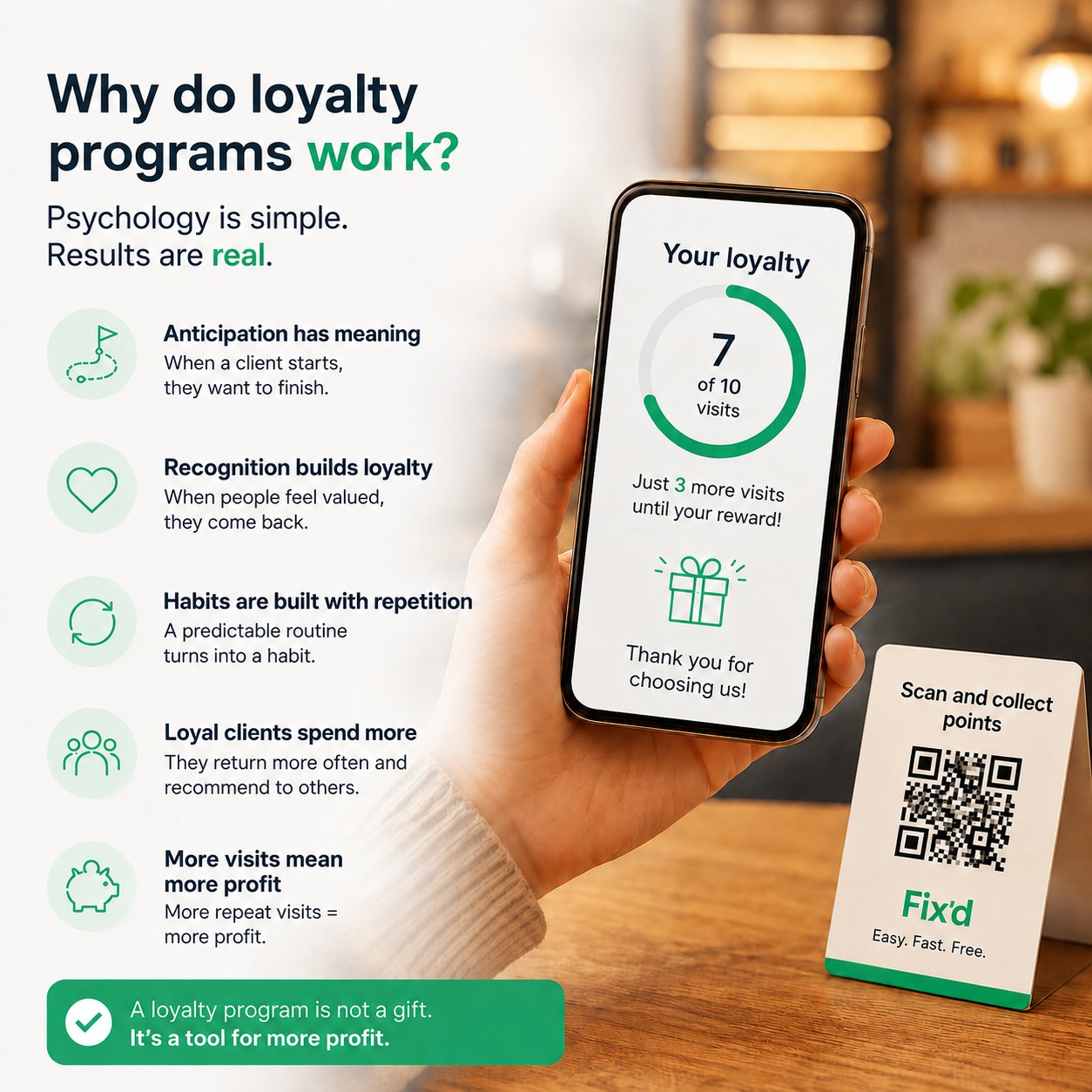
Why Loyalty Programs Work
Why Loyalty Programs Work
Loyalty programs are not a gimmick invented by supermarkets.
They work because they are built on something much older than points, stamps, cards, or apps: human behaviour.
People like progress. People respond to appreciation. People repeat choices that become easy. And people are more likely to return to a place where they have already started something.
That is why loyalty programs can work for large chains, but also for cafés, salons, barbers, bakeries, shops, restaurants, and local services.
A good loyalty program does not force loyalty. It creates small reasons to return until returning starts to feel natural.
Progress changes the next decision
The moment a customer earns a point, stamp, or visit credit, something changes.
Before that moment, they are just choosing where to buy. After that moment, they have started a small journey.
They may have one point out of ten. Or three visits out of eight. Or one completed step toward a reward.
Objectively, that may not seem like much. But psychologically, it matters.
Progress is hard to walk away from.
A half-filled stamp card is not just paper. A digital points balance is not just a number. It is unfinished progress. And unfinished progress has a quiet pull.
When the customer is choosing next time between two similar options, the place where they already have progress has an advantage.
Not because the reward is huge. Not because the customer made a formal commitment. But because they have already started.
Ownership makes rewards feel more valuable
There is a simple behavioural idea behind this: people value things more once they feel they own them.
A customer with points does not feel the same as a customer with nothing.
Even if the points are small, they feel like "my points." Even if the reward is still a few visits away, it feels like "my progress." Even if the value is modest, the customer feels they would lose something by ignoring it.
That feeling matters.
A loyalty program gives the customer a small piece of ownership in the relationship with the business. The customer is no longer just buying once. They are building toward something.
And when people are building toward something, they are more likely to continue.
Reciprocity is powerful
Loyalty programs also work because people respond to being appreciated.
When a business gives something back — a coffee, an upgrade, a small gift, a discount on a future visit, or a special reward — the customer often feels seen.
That feeling is commercially important.
A reward says:
- "We noticed that you came back."
- "We value your repeat visits."
- "We want to give you a reason to keep choosing us."
That is different from a generic discount offered to everyone.
A discount says, "Buy now because it is cheaper." A loyalty reward says, "Thank you for coming back."
That difference changes the tone of the relationship.
Customers do not usually return out of obligation. They return because the relationship feels slightly warmer, slightly more personal, and slightly more rewarding.
Predictability becomes habit
Loyalty programs also create rhythm.
If a customer knows that every visit moves them closer to a reward, each visit becomes part of a predictable pattern.
Buy. Earn. Progress. Return. Buy. Earn. Progress. Return. Then, eventually, receive the reward.
That rhythm is important because habits are built through repetition.
At first, the customer may consciously think:
"I'll go there because I'm collecting points."
Over time, that thought can become simpler:
"I'll just go there."
That is the real power of loyalty.
The program does not need to influence every decision forever. It only needs to help enough repeat decisions happen early enough that choosing the business starts to become automatic.
Loyalty reduces switching
Most customers do not make every purchase from one business.
A customer may like your café but still buy coffee elsewhere. They may like your salon but still go somewhere else when it is convenient. They may like your shop but still buy from competitors.
That is normal.
Loyalty programs help because they create a small cost to switching.
Not a financial penalty. Not a contract. Not pressure.
Just a simple thought:
"I already have progress there."
That thought can be enough to influence a marginal decision.
If two businesses are acceptable, the one where the customer is closer to a reward has a reason to win.
This is especially important for local businesses. A café, barber, salon, bakery, restaurant, or shop is rarely competing only with the place next door. It is competing with every convenient alternative in the customer's routine.
A loyalty program gives your business one more reason to be chosen again.
You do not need scale to see the effect
Large chains use loyalty programs because they work at scale.
But the psychology does not require scale.
- A single-location café can benefit when customers know their next few coffees count toward something.
- A barber can benefit when a customer knows they are two visits away from a reward.
- A salon can benefit when regular clients feel recognised for returning.
- A shop can benefit when customers see that repeat purchases are not forgotten.
The mechanics can be simple.
The customer does not need a complicated scheme. The staff do not need a long explanation. The business does not need to run a big corporate programme.
The customer needs to understand three things:
- What do I do?
- What do I earn?
- How close am I?
If those three things are clear, the program can start doing its job.
Why this matters for small businesses
For a small business, loyalty is not about creating a huge points economy.
It is about increasing the chance that a customer comes back one more time.
One more coffee. One more haircut. One more lunch. One more visit. One more purchase.
Those small repeat decisions are where profit is built.
A loyalty program works when it makes those repeat decisions easier, more visible, and more rewarding.
Not by tricking the customer.
By giving them a reason to continue a relationship they have already started.
So, why do loyalty programs work?
Because they connect to normal human behaviour.
We like to finish what we start. We value progress once we feel it is ours. We respond to appreciation. We repeat choices that become easy. And we are less likely to switch when staying gives us a visible benefit.
That is the real psychology behind loyalty programs.
Not gimmicks. Not tricks. Not just points.
A good loyalty program helps a customer return often enough for returning to become natural.
And once that happens, the business is no longer just another option.
It becomes the default choice.