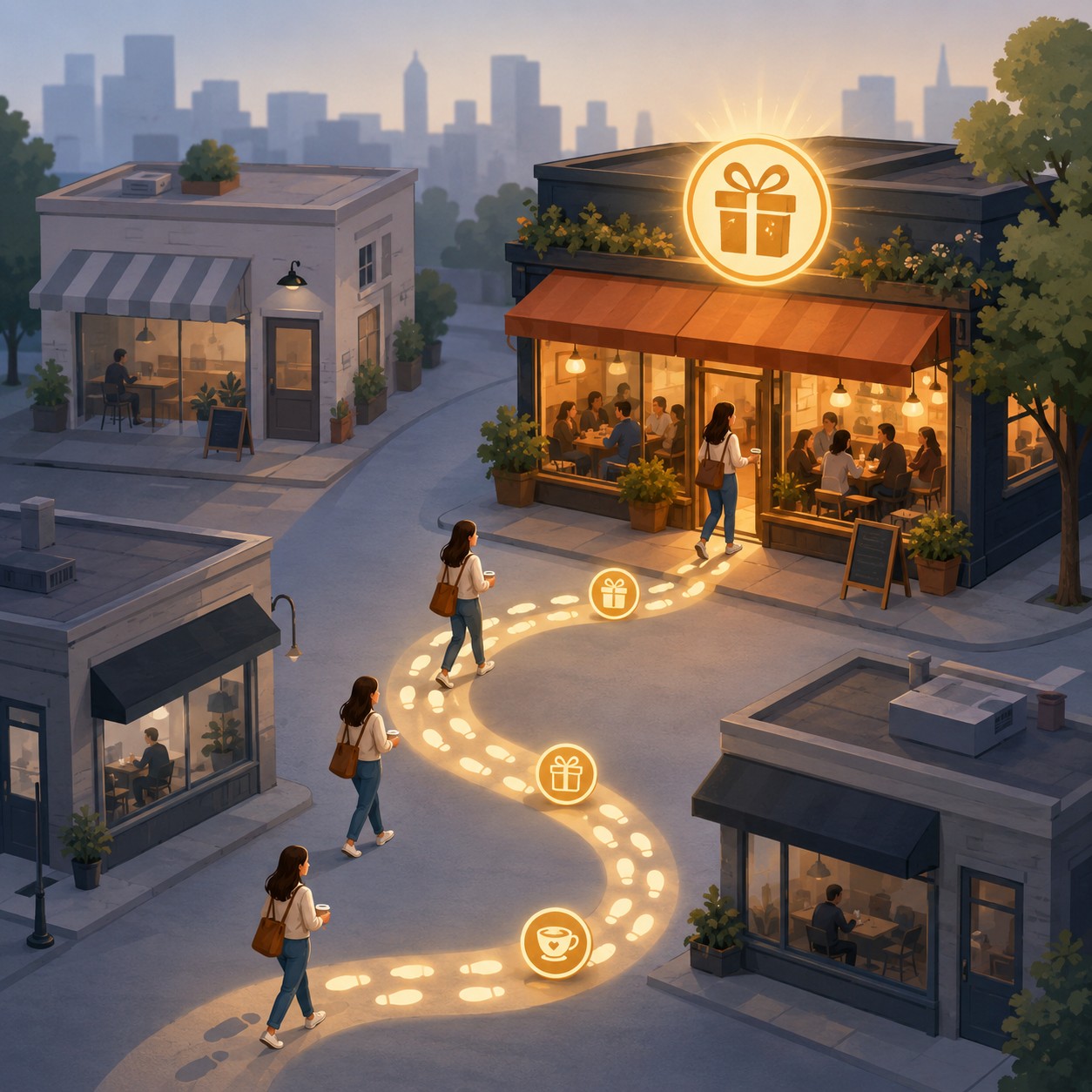
What Is a Loyalty Program, Really?
What Is a Loyalty Program, Really?
Most people think a loyalty program is a discount system.
Buy nine coffees, get the tenth free. Collect points. Get a reward. Come back again.
That is what a loyalty program looks like from the outside. But it is not what a loyalty program really is.
A loyalty program is a tool for forming a habit.
More precisely, it is a tool for helping your business become the customer's first choice when they need something you offer.
That distinction matters.
Because if a customer needs coffee, lunch, a haircut, a manicure, a car wash, or a glass of wine, they usually have options. Often many options. The real commercial question is not whether they like your business. The question is simpler and harder:
When the need appears, do they think of you first?
That is what loyalty is trying to achieve.
Loyalty is about the next decision
A customer does not become loyal because they once received a discount.
They become loyal when choosing you starts to feel natural.
At first, they may come because you are nearby. Or because a friend mentioned you. Or because they saw an ad. Or because they were curious.
But for that first visit to become a second visit, and then a third, something must happen. The customer needs a reason to return before the habit exists.
That is where a good loyalty program helps.
It creates visible progress. It gives the customer a small reason to choose you again. Not forever. Not magically. But often enough for repetition to start doing its work.
A habit does not form immediately. But once it forms, it can be durable.
That is the real value.
A discount is not the same thing as loyalty
Discounts can work. Promotions can work. A "20% off today" offer can bring someone through the door.
But a discount usually answers a different question:
"How do I get this person to buy now?"
A loyalty program answers:
"How do I give this person a reason to come back?"
Those are not the same.
A plain discount reduces the price of the current purchase. The customer gets the benefit immediately. The business gives up margin immediately. And then, after the transaction, the business hopes the customer will return.
That hope is often expensive.
To bring in new customers with discounts, you usually also need distribution: ads, boosted posts, flyers, influencers, marketplace visibility, or some other way to get the offer noticed. The cost is not only the discount. It is the discount plus the cost of attracting attention.
And when the promotion ends, the effect often fades.
Worse, heavy discounting can attract the least valuable type of customer: the bargain-seeker. This customer is not choosing you because they prefer you. They are choosing the deal. When a better deal appears somewhere else, they leave.
That does not mean promotions are useless. They can be useful for launches, quiet days, stock clearance, or special campaigns. But they are not, by themselves, a loyalty strategy.
The cost of loyalty is different
The economics of a loyalty program are different from the economics of a discount.
A discount is usually front-loaded.
The customer gets the benefit now. The business gives up margin now. The hoped-for repeat behavior comes later, if it comes at all.
A loyalty reward is back-loaded.
The customer receives the benefit only after showing repeat behavior. They come several times, make several purchases, and only then receive the reward.
That is a very different commercial structure.
The business is not paying upfront for a promise. It is rewarding demonstrated behavior.
This is why a simple "buy X, get something on the Xth visit" structure can be powerful. The customer sees progress. The business sees repeat visits before the reward is given. The reward becomes a consequence of loyalty, not a bribe offered before loyalty exists.
The reward should support the purchase, not replace it
A good loyalty reward is not just generous. It is well-structured.
One mistake businesses make is giving away something that becomes a standalone reason to visit. That can create cost without strengthening the normal buying habit.
A better reward often complements the purchase.
For example, instead of giving something that replaces the customer's normal order entirely, the reward can enhance the transaction: a free dessert with the tenth coffee, an upgrade, an add-on, a small service, a premium option, or a reward that still leaves the visit profitable.
The best loyalty rewards feel meaningful to the customer but remain economically sensible for the business.
That is the balance.
- Too weak, and the customer does not care.
- Too expensive, and the program becomes a margin leak.
- Too immediate, and it becomes just another discount.
- Too complicated, and nobody uses it.
A good loyalty program sits in the middle: simple, visible, achievable, and profitable.
Progress is the engine
The most important part of a loyalty program is not the reward itself.
It is progress.
A customer with zero progress is just a customer.
A customer with six out of ten visits completed is in the middle of a journey.
That changes the next decision.
If they are choosing between two similar places, the one where they already have progress has an advantage. The reward does not need to be huge. The point is that the customer has already started.
This is why loyalty programs work best when the customer can easily understand three things:
- Where am I now?
- What do I get?
- How close am I?
If those three things are clear, the program becomes part of the customer's decision-making. Not aggressively. Not with pressure. Just as a small nudge at the right moment.
And many customer decisions are made at exactly that margin.
Loyalty is not magic
A loyalty program will not fix a bad product. It will not compensate for poor service. It will not make customers return to a place they actively dislike.
But if the underlying experience is good, a loyalty program can help convert occasional customers into repeat customers.
That is the practical goal.
Not to "buy loyalty." Not to give things away. Not to run permanent discounts.
The goal is to make returning easier, more rewarding, and more natural.
In a competitive local market, that matters. A customer may pass ten cafés, salons, bars, bakeries, restaurants, or shops in a normal week. Many of them are good enough. Many of them are convenient enough.
The question is: which one becomes the default?
That is what a loyalty program is really for.
So, what is a loyalty program?
A loyalty program is not a discount. It is not a giveaway. It is not a trick.
A loyalty program is a structured reason for a customer to come back until coming back becomes a habit.
Used well, it protects margin better than constant discounting, rewards customers after they have shown repeat behavior, and helps your business become the first choice when the customer is ready to buy again.
And that is the real prize.
Not one more transaction.
The next habit.