We Tested Fix'd on Our Children. It Taught Us More About Loyalty Than Parenting.
We Tested Fix'd on Our Children. It Taught Us More About Loyalty Than Parenting.
Fix'd was built to help businesses reward behaviour they would like customers to repeat.
During the summer holiday, we decided to test the same logic on our own children.
The experiment was loosely inspired by the Norwegian positive-reinforcement approach to parenting: reward desired behaviour, explain the consequences of choices and avoid automatically responding to undesirable behaviour with yelling, grounding or the removal of privileges.
Instead of:
"Your room is a mess, so you are losing your screen time."
The system would simply say:
"You did not complete today's activities, so you did not earn today's point."
Nothing was taken away. There was no penalty. There was only an opportunity to earn something extra.
It sounded simple.
In practice, it became an experiment in reward design, consistency, habit formation and parental self-control.
It also turned out to be a surprisingly relevant lesson in how businesses should structure loyalty programs.
The program
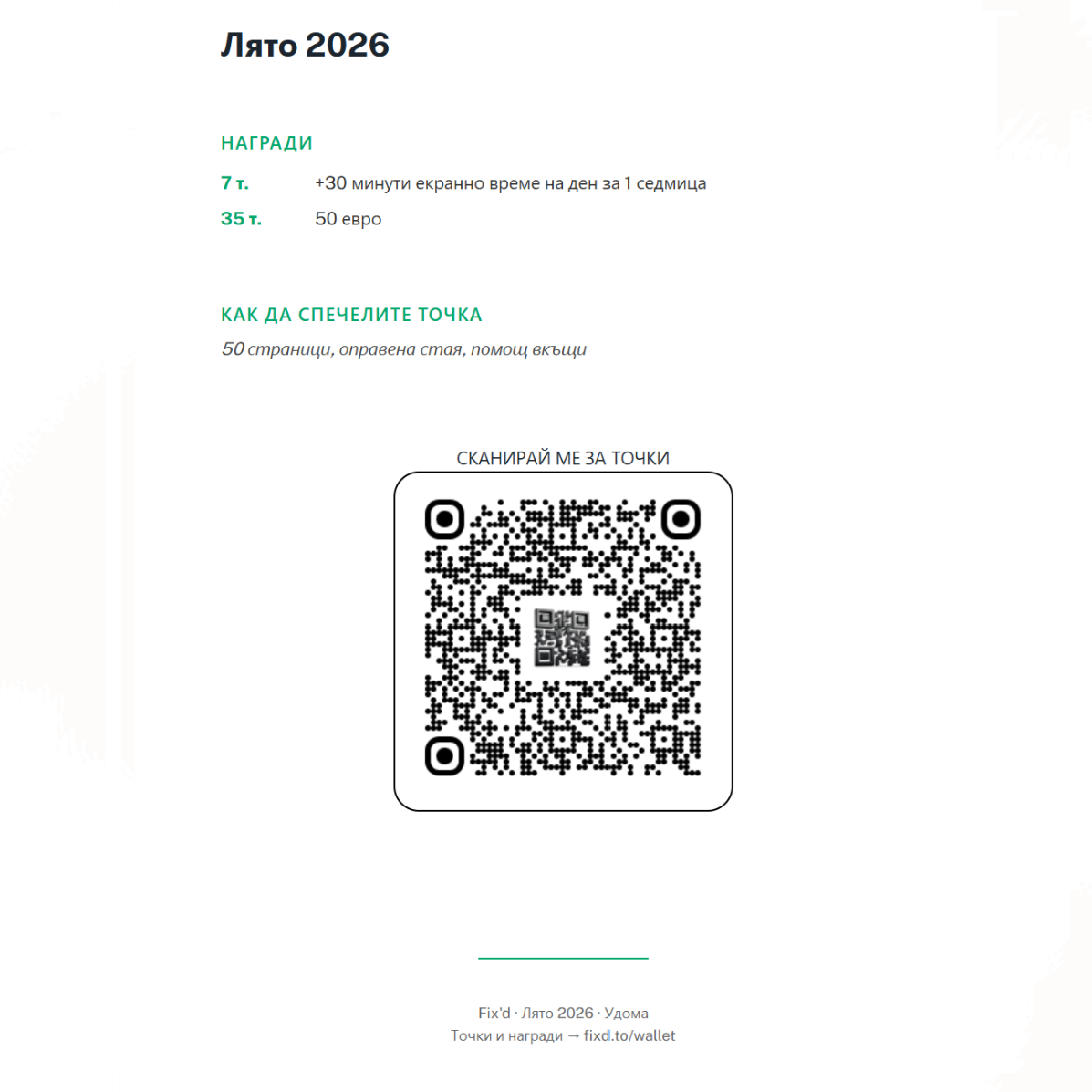
We created a two-tier reward ladder in Fix'd:
- 7 points: 30 additional minutes of screen time each day for one week
- 35 points: a EUR 50 bonus
The image accompanying this post is the actual live program sheet we used at home. It is not a mock-up created for the article.
The QR code is real too.
Obviously, we did not want the children awarding themselves points, so the program was code-protected. They could scan the QR themselves, but earning the point required a code that we held. Once we had verified that all three activities had been completed, we provided the code and the point could be earned.
So progress was theirs to make, but not theirs to certify.
To earn one point, the children had to complete all three activities during the day:
- Clean their room and keep it reasonably tidy.
- Read 50 pages of a book.
- Help with a household chore without being prompted.
The program ran — and in fact is still running — during this summer holiday, when our children had enough free time to complete the activities without the demands of school.
We also did occasional random checks on the reading. We might ask what had happened in a particular chapter or ask them to explain part of the story.
The purpose was not to catch them out. But if progress is being rewarded, there has to be at least some confidence that the required activity actually happened.
Complete all three activities, earn one point.
Complete two, earn no point.
There were no partial points, no negotiations and no points awarded because someone had "almost" done everything.
We deliberately did not turn missed points into punishment
One of the most important choices was what we did not do.
When the children failed to complete all three activities, we did not announce:
"No point for you today."
We did not point dramatically at the untidy room. We did not use the missed point as an opportunity for a lecture about responsibility. We did not try to create an emotional consequence around it.
They simply did not receive a point.
That may sound like a small distinction, but it mattered.
The purpose was to keep the program focused on the upside. Completing the activities moved them towards a reward. Not completing them left them where they were.
The missed opportunity was the consequence.
Of course, questions still came up.
"Can I have some more screen time? It is the summer holiday."
Previously, that might have become a negotiation:
"Fine, but first clean your room and take out the rubbish."
Or, depending on the state of the room and our mood:
"Absolutely not. Look at this mess."
Under the program, the answer was simpler.
Additional screen time was a reward in Fix'd. It had a defined price. The conditions for earning it were already known.
We stuck to the rule.
That consistency was not always effortless. For a parent, it takes a surprising amount of restraint to walk into a messy room, say nothing and allow the system to do its work.
But the rule stopped changing according to our mood.
The children no longer had to guess whether more screen time could be negotiated on that particular day. We no longer distributed rewards because we felt generous or removed privileges because we felt frustrated.
The program created a boundary for everyone, including us.
What happened
The first seven-point reward was claimed after 15 days.
The children could have continued saving towards the EUR 50 reward at 35 points. Instead, they chose the immediate reward: 30 additional minutes of screen time each day for one week.
Redeeming used the accumulated points and returned the balance to zero.
The second seven-point reward was claimed on day 24.
Once again, they chose the screen-time reward rather than continuing towards the EUR 50.
After the second redemption, their behaviour became more consistent. Based on the pace of progress, the third reward looks likely to be claimed on day 31 — a perfect seven-day run.
The time between rewards was compressing:
- 15 days for the first reward
- 9 additional days for the second
- potentially 7 days for the third
That progression was probably the most interesting result.
The first reward required the children to understand the system and decide whether the effort was worth it. By the second cycle, the behaviour was becoming more familiar. By the third, it was beginning to resemble a routine.
The reward did not instantly create a habit.
It helped the habit form gradually.
The first reward taught the program
In loyalty programs, we often focus on the reward itself.
But the first reward has another function: it teaches the user how the program works.
At the beginning of our experiment, the children had no established routine around earning the point. They had to remember all three activities, complete them and connect that effort with progress towards something they wanted.
The first 15 days were therefore not just about earning seven points.
They were about learning the behaviour.
After the first redemption, the full cycle became real:
Complete the activities. Earn points. See progress. Reach the reward. Redeem it. Start again.
The second cycle was faster because the program was no longer theoretical.
For a business, the equivalent is not merely putting a QR code on the counter and waiting.
The business needs to help the customer perform the behaviour enough times for it to become familiar.
That means actively offering the scan, especially at the beginning:
"Would you like to collect your point?"
"Do not forget to scan."
"You are only two points away from your reward."
The initial scan may require a prompt. The second may require another.
Eventually, the customer begins to remember without being asked.
This is the commercial equivalent of the time compression we observed at home.
The first reward establishes the program.
Repeated participation builds the habit.
Over time, scanning becomes part of the purchase rather than an additional task attached to it.
Make the first reward inexpensive for the business but desirable for the customer
We deliberately chose two very different rewards.
The first reward — additional screen time — was highly desirable to the children but cost us almost nothing financially.
There was some parental cost, of course. We had to accept the extra screen time and live with the fact that we had promised it.
But compared with handing over EUR 50, it was inexpensive.
The second reward was deliberately more valuable and substantially more costly.
This is also a useful way for a business to think about a reward ladder.
The first reward should be attainable, desirable and inexpensive to deliver.
It does not need to be a major discount.
A coffee shop might offer:
- An additional espresso shot
- A larger drink for the price of a smaller one
- A syrup or milk upgrade
- A small item with a low marginal cost
A barbershop might offer:
- Complimentary styling
- A beard-line touch-up
- A product sample
- A small service enhancement that feels personal
A restaurant might offer:
- A dessert upgrade
- A side dish
- A coffee after the meal
- A modest complimentary extra
The customer should feel that the reward is worth earning.
But the business should not have to sacrifice a large part of the transaction to provide it.
In our experiment, the children repeatedly chose the smaller reward.
The EUR 50 reward was never really there to be redeemed. It was the anchor.
Its distance made the seven-point reward look like the obvious, sensible choice.
A large reward sitting five times farther up the ladder can do exactly this job: it gives customers something to aspire to and, by comparison, makes the reachable milestone feel easy.
The seven-point reward did the actual work of sustaining participation.
It created reachable progress.
A distant reward may look better than it performs
From the perspective of program design, the EUR 50 reward was obviously more impressive.
It had a clear monetary value. It sounded substantial. It appeared to provide a strong incentive.
But it was five times farther away, and the children repeatedly preferred a smaller reward they could obtain now.
This is a common mistake in loyalty design.
A business creates a reward that sounds generous:
"Buy 20 and get one free."
On paper, it looks attractive.
In practice, the customer may never feel close enough to it to care.
Theoretical value is not the same as motivational value.
The useful question is not only:
"How much is this reward worth?"
It is also:
"How soon can the customer realistically experience success?"
A smaller reward can outperform a larger one because it creates momentum.
The customer reaches it, enjoys it and learns that the program produces a real benefit.
Once that happens, continuing feels more rational.
The stick might have produced better compliance
There is also an uncomfortable part of the experiment.
Had we used punishment, we would have achieved more consistent results.
Previously, an untidy room led to lost screen time, grounding or another immediate negative consequence, so eventually we usually got tidy rooms and rubbish taken out.
Fear of loss is powerful.
A child cleans a room more reliably to avoid punishment than to earn one point towards a future reward.
But that result came with a higher emotional cost.
There was more conflict, resentment and stress — particularly for the children, although not only for them.
The stick created compliance.
It did not create willingness.
This distinction matters for businesses because, in most customer relationships, the stick is not available.
A coffee shop cannot punish someone for failing to return.
A barber cannot ground a customer who books elsewhere.
A restaurant cannot remove a privilege because a guest has not visited for three weeks.
Customers are free to leave.
The business can only make returning more attractive.
That means the carrot has to work.
The experience has to be pleasant. The reward has to be understandable. The progress has to feel achievable. The customer has to feel that participation is worth the small amount of effort required.
A loyalty program is not a system for forcing behaviour.
It is a system for making desired behaviour easier to choose again.
Loyalty programs also discipline the business
The experiment did not only change our children's behaviour.
It changed ours.
Before the program, rewards were arbitrary.
Additional screen time was granted because it was the summer holiday. It was withheld because we were tired or frustrated with work. A chore was exchanged for an immediate privilege in the middle of a negotiation.
Once the program existed, we had to follow it.
The reward had a price.
The actions required to earn it were defined.
The children's progress was visible.
That consistency made the system more credible.
The same applies to businesses.
Without a defined loyalty structure, rewards are often improvised:
"This customer comes often, so give them something."
"They complained last time, so add a discount."
"They asked nicely, so make an exception."
"There is no manager here, so we cannot approve it."
A formal program replaces improvisation with a promise:
Do this, earn that.
The rules become understandable to the customer and operationally easier for the business.
That does not eliminate judgement. But it reduces the number of situations in which loyalty depends on who is working, how well the customer negotiates or whether someone happens to remember them.
Was this the best parenting method?
No.
It worked here because the stakes were low.
An untidy room or a missed reading target is not a serious danger, so we could afford to let the children choose and accept that some days would produce no point.
In higher-stakes situations — safety, health, serious school responsibilities, conduct that affects other people — we would not rely on gradual reward-based habit formation alone.
Some behaviours need firmer boundaries and more immediate consequences.
This was one family, during a summer holiday, testing one system on a narrow set of behaviours.
The conclusion is not that punishment is never necessary.
It is that where the stakes are low enough to allow it, a clear reward system can shape behaviour without turning every failure into a confrontation.
The broader lesson
Our children did not suddenly become perfectly tidy, enthusiastic readers and devoted household assistants.
The program did not produce flawless compliance.
What it did was create a visible connection between repeated behaviour and a desirable outcome.
The first reward took 15 days.
The second came 9 days later.
The third appears likely to take seven.
That compression suggests the behaviour was becoming easier to repeat.
Not because anyone was threatened.
Not because privileges were removed.
Not because we argued more effectively.
Because the rules were clear, the progress was visible and the reward felt close enough to matter.
That is also what a well-designed loyalty program should do for a business.
It should not attempt to buy permanent loyalty with one large giveaway.
It should give customers a small reason to return, help them repeat the behaviour and gradually make participation feel natural.
Fix'd kept the score.
The reward created the motivation.
Repetition began to create the habit.