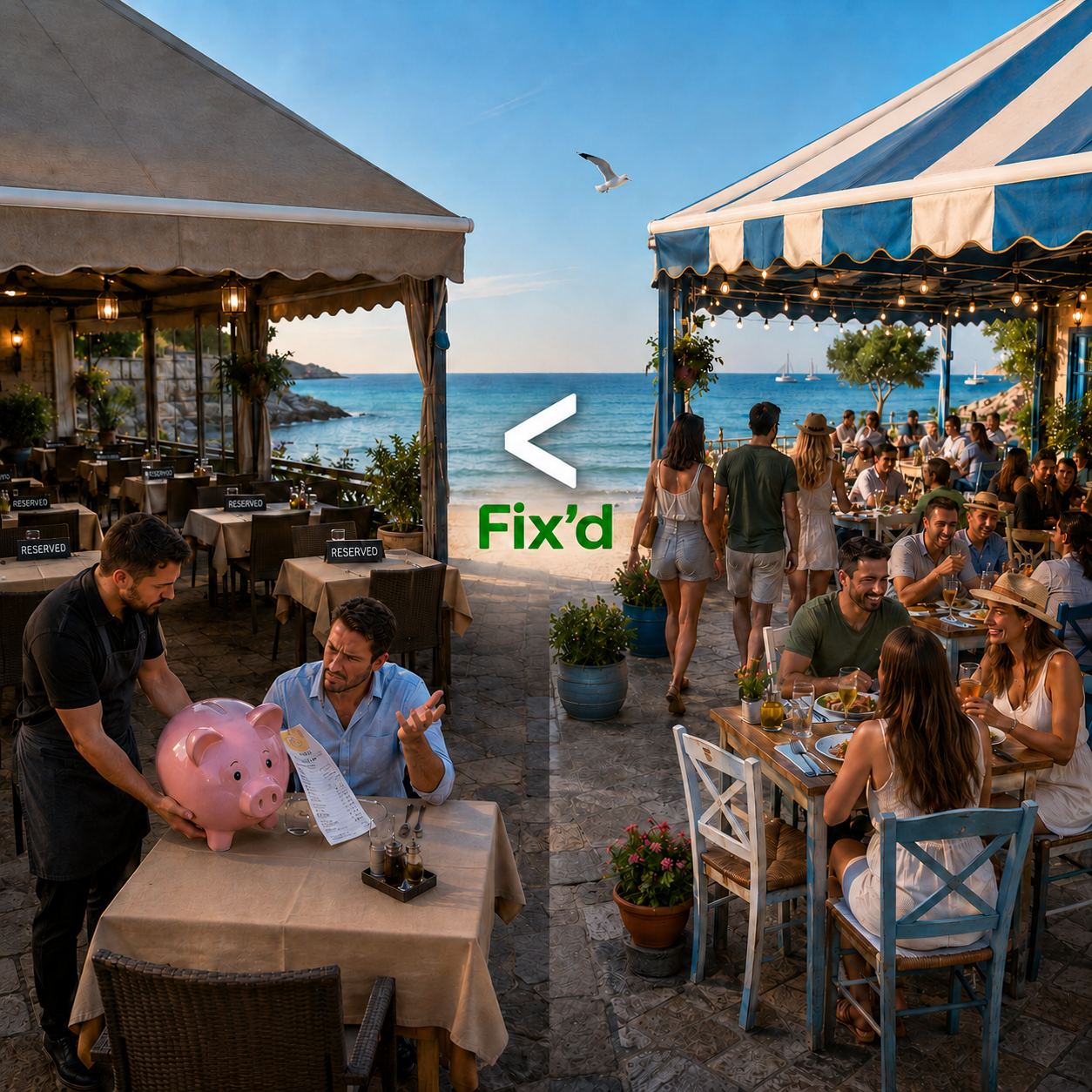
Don't Maximize the Bill. Maximize the Entire Stay.
Don't Maximize the Bill. Maximize the Entire Stay.
Every summer, we compare Bulgaria and Greece.
We compare prices, food, service, beaches and the feeling tourists are left with when the holiday is over.
But for a seaside business, there is a more useful question:
Is it more profitable to take as much as possible from the customer today—or to give them a reason to return several more times before their holiday ends?
We believe that many businesses in tourist destinations currently make a completely understandable, but often suboptimal, decision.
They try to maximize the value of every individual bill.
They could instead maximize the value of the customer over their entire stay.
The difference between the two can be the difference between:
"That wasn't worth the money."
and:
"That was absolutely worth it."
Not only for the tourist.
For the business too.
The current behaviour is not irrational
Let us begin by looking at the situation from the owner's perspective.
A seasonal business is difficult.
You may have only three or four months to generate enough revenue to justify the investment, risk and work involved throughout the year.
In reality, the strongest part of the season may last only six weeks.
During that time, you need to find staff, pay increasingly high wages, cover rent, supplies, equipment, maintenance and all the unpredictable costs that weather and tourist traffic can bring.
At the same time, competition is everywhere.
Walk fifty metres and you will find another restaurant with a similar menu.
Another café serving similar drinks.
Another bar offering almost the same cocktails.
Meaningful differentiation can be genuinely difficult.
So we understand the natural instinct:
The customer is here now. We need to maximize the value of this sale.
You do not know whether they will return tomorrow.
You do not know whether they will leave the resort in two days.
You do not know whether their next dinner will be at the business next door.
When the future is uncertain, today's bill looks like the only reliable opportunity.
This is not necessarily greed.
It is not automatically poor treatment.
It is not irrational.
It is a logical response to uncertainty.
But the logical decision is not always the best one.
The problem is that the business may be optimizing the wrong thing.
It is optimizing the bill.
It could be optimizing the entire stay.
A tourist's lifetime may be only one week
We usually talk about tourists as one-time customers.
In one sense, that is true.
A family may visit a particular resort only once this year. They may never return to the same town.
But they will probably stay for five to ten days.
During those days, they will make the same purchases repeatedly.
Coffee. Breakfast. Lunch. An iced coffee or beer on the beach. Ice cream in the afternoon. A drink before dinner. Dinner. Sometimes a bar afterwards.
The next day, the cycle begins again.
Those purchases will happen anyway.
The question is not whether the tourist will buy.
The question is where.
That is why customer lifetime value does not always need to be measured in years.
For a seaside restaurant or café, it may last only one week.
But one week can be more than enough to build a more profitable relationship.
You may earn a very high margin on tonight's dinner, but leave the customer feeling that it was not worth the price.
You have then won one bill and probably lost the next three.
You may earn slightly less from the first visit but give the customer a clear reason to return.
Then you do not simply win the dinner.
You win the week.
This is not charity.
It is not a rejection of profit.
It is one business model replacing another.
A lower margin does not necessarily mean lower profit
The discussion about seaside prices is often reduced to two extremes.
On one side is the tourist: "Lower your prices."
On the other is the business: "With such a short season, we cannot afford to operate cheaply."
Both sides may be right.
The choice is not necessarily between high prices and profitability on one side, and low prices and bankruptcy on the other.
The real choice is between maximum margin from one transaction and maximum total value from one customer.
You do not need to be the cheapest place in the resort.
You do not need to reduce every price.
You need to offer a combination of price, quality and experience that makes the right customer want to return.
That may mean clearer pricing. Fewer unpleasant surprises on the bill. Slightly better value. More consistent service. And a specific reason to make another visit.
Once you can influence the return, the economics change.
A slightly lower margin becomes acceptable if you expect more purchases.
You no longer need to replace every one-time customer with a new one.
Demand becomes more predictable.
Staff begin serving faces they recognize.
And the customer feels that you are trying to earn their business throughout the holiday rather than extract the greatest possible value from one bill.
A self-reinforcing model begins to form:
Better value encourages another visit. Another visit creates more stable demand. More stable demand reduces the pressure to maximize every bill. And the better experience generates even more repeat visits.
Loyalty does not create demand. It directs it.
Loyalty programmes are usually described through their rewards.
Collect five points. Receive a free coffee. Make three visits. Get a dessert.
That is the visible part.
For a seasonal business, the more important function is different: managing repeat demand.
The tourist will probably drink coffee tomorrow anyway.
The programme gives them a reason to drink it at your café.
The family will probably have dinner again.
The programme increases the probability that they choose your restaurant.
You are not creating a need that did not previously exist.
You are directing existing demand toward your business.
That is precisely why tourist destinations are so suitable for loyalty programmes.
The customer remains within a relatively small area.
They make frequent purchases.
Competitors are only a few steps away.
And the holiday is short, which means progress toward a reward feels immediate.
The reward does not need to be extravagant.
It only needs to be meaningful enough to influence the next decision.
"Come back twice and dessert is on us." "Five visits and your next coffee is free." "Collect ten points before your holiday ends."
You are no longer simply hoping that the customer returns.
You are managing the probability that they will.
Loyalty naturally selects the right customers
There is another important advantage.
Loyalty is not for everyone.
And it should not be.
A customer leaving the resort tomorrow will probably not complete the programme.
Someone who wants to try a different restaurant every day may not participate either.
A customer motivated only by the lowest available price will probably choose another business as soon as a cheaper offer appears.
A person who is consistently dissatisfied may never be won over, regardless of what you offer.
That is not a failure of the programme.
It is natural selection.
Loyalty works best with customers who like the business, are staying long enough, can see a reason to return, and value the combination of price, quality and service.
Those are also the customers who are most suitable for the business.
You do not need to reward everyone.
You do not need to persuade every tourist.
You need to give the right customers a reason to choose you again.
Reservations are also a rational response to uncertainty
There is another familiar summer frustration.
You enter a restaurant that appears half empty.
But almost every table is marked "Reserved."
To the customer, this seems illogical.
To the owner, there is a reason.
The reservation protects future revenue.
Someone is expected to arrive later and use that table.
If you give it to a walk-in customer now, you risk having nowhere to seat the person who made the reservation.
Here too, the behaviour is understandable.
But again, it may be suboptimal.
A table sitting empty while waiting for a future customer cannot serve the person standing at the door now.
The business rejects real demand today in order to protect expected demand later.
Sometimes that is the correct decision.
But when too much capacity is held in reserve, particularly in a location with strong foot traffic, the business is buying certainty at the cost of empty tables.
We would reverse the ratio.
We would keep most places available on a first-come, first-served basis.
We would serve the demand that actually appears.
A smaller share of capacity would be reserved for customers who had already demonstrated their value.
An open table is not only capacity. It is customer acquisition.
A walk-in customer is not simply another bill.
They are a potential regular.
First, they try the food. Then they join the programme. They return the next day. After several visits, they already recognize the staff, the menu and the venue.
Some of these customers will return twice. Others five times. Some will become the most valuable customers of the week.
That is why open capacity is not simply empty seating.
It is the beginning of the process of acquiring and retaining a customer.
A large buffer of reserved tables may protect future demand.
But it may also block the people who could become tomorrow's regulars.
The strongest model, in our view, combines open access for new customers with earned privilege for the most valuable ones.
Two programmes with two different purposes
We would not try to solve everything with one mechanism.
We would use two complementary programmes.
The first rewards visits
Every return moves the customer closer to a reward.
The objective is simple: more visits during the holiday.
This programme says: "Thank you for coming back."
The second recognizes value
It does not necessarily offer larger discounts.
Customers who spend more and create more value for the business can unlock privileges.
Priority reservations. A preferred table when one is available. A small gesture from the staff. A benefit that is not part of the standard visit-based programme.
This programme says: "We recognize the value of your continued business."
The distinction matters.
A regular customer may appreciate a reward.
A high-value customer may appreciate convenience more than another free drink.
And when spending is verified through one-off QR codes, recognition does not depend on staff memory, personal relationships or a manager's subjective decision about who is "important."
The customer earns the privilege through real behaviour.
Merit, not favouritism.
Recognition can be more valuable than a discount
When we talk about loyalty, we often think only about rewards and discounts.
But the most valuable customers do not always want a larger discount.
They often want less friction.
They want to know that a table will be available.
They want staff to recognize them.
They want their repeated choice to be noticed.
That feeling can have considerable value for the customer and a very low cost for the business.
It also creates a better story.
Few people tell their friends: "They gave me a five-percent discount."
But they do say: "We went several times and they started recognizing us." "They always found a way to seat us." "They treated us like regulars, even though we were only there for one week."
That is a powerful recommendation because it is specific.
And because the treatment was earned.
Not through knowing the owner.
Not through having a friend behind the bar.
But through repeatedly choosing the business.
Word of mouth strengthens the entire model
A customer who feels they received fair value is more likely to return.
A customer who feels recognized is more likely to talk.
Those stories bring new people into the business.
Someone hears that the restaurant offers good value.
They hear that regular customers are treated well.
They decide to try it.
Because most tables are available to walk-in customers, they are actually able to sit down.
They join the programme.
They return.
They may become a regular customer.
They may become a high-value customer.
Even within the short lifetime of a single summer holiday, a customer base begins to form.
Better value creates repeat visits. Repeat visits create recognition. Recognition creates stories. Stories bring new customers. And the cycle begins again.
The better experience may also be the more profitable model
This approach does not mean that the business should ignore its costs.
It does not mean that every seaside price is too high.
It does not mean that the owner should abandon healthy margins and hope customers appreciate the gesture.
The argument is much more commercial:
Maximizing every individual bill may produce less total profit than maximizing the customer's value over their entire stay.
A slightly lower margin may be offset by more visits.
More open tables may improve capacity utilization.
Walk-in visitors may become regular customers.
Regular customers may become high-value customers.
The most valuable customers can be recognized without giving everyone a large discount.
And positive word of mouth may create new demand that the business did not pay to acquire.
The current model is not irrational.
We understand why an owner chooses it.
When the future is uncertain, the maximum available margin today appears to be the safest decision.
But the repeat visit is not entirely outside the business's control.
It can be influenced. It can be encouraged. It can be managed.
And when the business begins managing the return, the economics change.
The real choice is not: "Should I earn more today or hope that the customer returns tomorrow?"
The real choice is: "Should I maximize one transaction or deliberately build several?"
Where Fix'd fits
Fix'd does not invent this strategy.
The owner chooses it.
Fix'd makes it practical.
A business can create a visit-based programme that gives tourists a specific reason to return before their holiday ends.
It can use a separate spend-based programme, supported by one-off QR codes, to recognize its highest-value customers.
It can reward frequency and recognize value.
It can keep most of its capacity available on a first-come, first-served basis while preserving limited priority access for customers who have earned it.
And it can do all of this without requiring an app or another physical card.
The objective is not to give away more.
The objective is to earn more from the customer's entire stay while giving that customer a better reason to return.
Because the most profitable decision may not be to maximize today's bill.
It may be to make sure there is another one tomorrow.
And if more businesses on the Bulgarian coast begin to see that maximizing the entire stay can be more profitable than maximizing one bill, perhaps in a few summers our social feeds will contain fewer photographs of restaurant receipts and more photographs of sunsets—from Durankulak to Rezovo.